
Revisited Dickens’ The Signalman yet again, this time with my daughter who is studying for Key Stage 3. It’s a wonderfully dank tale: you feel the steady loss of light as you read into its depths; like going down candle lit stairs into a neglected cellar; all cobwebs, unnerving sounds and silhouettes.
The story ‘s power emanates perhaps from its unnerving exploration of disorientation. This disorientation is created by Dickens’ masterly deployment of a first person narrator whose ‘raison d’etre‘ or character remains obscure and even ambivalent. For just like the narrator/interloper in Poe’s dark tale, The Fall of the House of Usher, the story opens with a visitor calling upon some lonely figure who seems to be suffering from an undisclosed, terrible sickness. This affliction both Dickens’ and Poe’s narrators suspect, is as much a mental as a physical disease.
If Poe’s illness is a sign of Usher’s moral corruption, then Dickens’ Signalman’s illness is a sign of his inability to decipher the catastrophic ‘signals’ that haunt him. This is darkly ironic as he is supposedly a protector, a guardian of safety, yet finds himself a victim, preyed upon by signs he cannot understand.
Contrast the signalman’s predicament to that of the murderous Macbeth, who accepts the veracity of the witches’ signs, accepting their diabolical truths. Remember that the signalman is made ill by his inability to avert the disasters foretold by the supernatural signals, and is ultimately killed by his overwhelming confusion and fear about the truthfulness of the ‘sign’.
Interestingly if their illnesses are of the mind(dis-ease) then we are not too far away in sensibility from Robert Louis Stevenson’s late 19thC. novel, Dr Jekyll and Mr Hyde where we hear all too symbolically, the protagonist’s bleak request that: ‘You must suffer me to go my own dark way.” Suffering whether self inflicted or from ungovernable external forces takes place in an atmosphere of nightmare. Little surprise then, that all three texts are haunted by feverish imaginings and hallucinatory visions for in each text, as in Dante’s Inferno , we are in hell’s kingdom.
Look at the opening words spoken by the anonymous narrator: ” Halloa! Below there! ” These apparently cheerful words are progressively identified as some ironic echo of a spectral voice, foretelling disaster, in an act of consummate ventriloquism where the dead and the alive are mixed together, so that they cannot be differentiated.
It is as if our voices can be hijacked, borrowed by supernatural forces! Passed on….
This lack of easy differentiation between the living and the dead, drenches the narrative in uneasy symbolism. For when comprehension is difficult, we resort to symbolism to make sense of the tale. ” Is there any path by which I can come down and speak to you?” Such a question seems metaphysical even at this point and we suspect that the ‘path’ available might be a path that leads into a nether world, as we go down and down into obscurity and the world of night. A gloomy, solitary dungeon, where the signalman feels persecuted for his lack of understanding.
We are in an antisocial place where antisocial events take place, all shrouded in mystery and incomprehensible signals. Notice how the narrator is perplexed by the signalman’s behaviour; he is perceptually disorientated, perceptually bewildered!

Halloa! Below there!”
When he heard a voice thus calling to him, he was standing at the door of his box, with a flag in his hand, furled round its short pole. One would have thought, considering the nature of the ground, that he could not have doubted from what quarter the voice came; but instead of looking up to where I stood on the top of the steep cutting nearly over his head, he turned himself about, and looked down the Line. There was something remarkable in his manner of doing so, though I could not have said for my life what. But I know it was remarkable enough to attract my notice, even though his figure was foreshortened and shadowed, down in the deep trench, and mine was high above him, so steeped in the glow of an angry sunset, that I had shaded my eyes with my hand before I saw him at all.
“Halloa! Below!”
From looking down the Line, he turned himself about again, and, raising his eyes, saw my figure high above him.
“Is there any path by which I can come down and speak to you?”
He looked up at me without replying, and I looked down at him without pressing him too soon with a repetition of my idle question. Just then there came a vague vibration in the earth and air, quickly changing into a violent pulsation, and an oncoming rush that caused me to start back, as though it had force to draw me down. When such vapour as rose to my height from this rapid train had passed me, and was skimming away over the landscape, I looked down again, and saw him refurling the flag he had shown while the train went by.

(The Original analysis)
This story tantalises as it slips away from the reader’s grasp at ‘truth’. For where is ‘truth’ in this story? Should we believe the fears of the lonely, isolated signalman who believes he is being haunted by a figure of nemesis foretelling death and destruction? Or should we view such terrible, repetitions of horror as the symptoms of a sick dis-eased mind, and cling to the rational observations of the unnamed narrator and visitor to the signalman’s solitary world?
My son is studying this text for his English Literature GCSE and I am very grateful to have a reason to reread this text which refuses to declare its full significance and which evades our ability to locate and name ‘truth’.
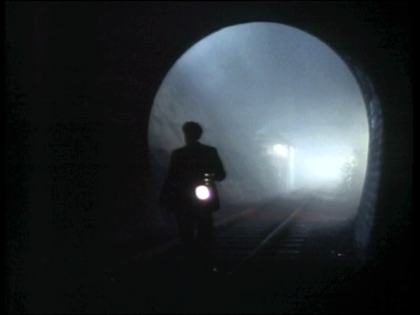
My first assumption centred on a dislike of the narrator who seemed a rather malignant interloper into the crypt-like wolrd of the signalman. The narrator’s words ironically mirror those of the signalman’s nemesis and it seemed quite possible to this reader that the narrator IS the nemesis without perhaps even realising this in any conscious or direct way.
I do wonder too at Dickens’ superb ability to explore the tension between repetition and coincidence, and the ambivalence of coincidence when it becomes symbolically retranslated by an unnerved mind, as fate. Lives are riddled by patterns (and our desire to discern and recognise patterns) and in this story the bemused and bedevilled signalman finds the revisitations of both nemesis and narrator so unsettling that it seems he chooses to embrace the certainty of literal extinction rather than the mentally destabilising uncertainty of progressive mental terror.
The Signalman, as the story’s title insinuates, explores the lonely predicament of a railway worker whose daily rituals are primarily concerned with safety. His literal ‘signals’ avert death. Yet the story’s dramatic irony reveals the strange ‘signals’ that the story’s protagonist appears to be receiving from a source unknown; revenant perhaps or just misunderstood manifestations of a lonely mind?
The extract above is taken from the opening of the story and I love the disorientating feel of the setting. Where is the narrator and where is the signalman? And how are these geographical positions crucial to our understanding of the story and even its possible resolution? For the dark, deep crypt-like situation of the signalman with the damp, gloomy aspect is suggestive of hell, of a ‘fallen’ post Edenic world. Such a setting is mirrored by the feverish quality of the signalman’s words, who attaches a disturbing fatalism to the actions and utterances of the haunting figure. If Dickens’ did rightly ( from direct experience of a railway crash) attach considerable danger to Victorian Industrialization and railway system, then the sinister, monstrous appearance of the steam train hurtling out of its dark, tunnel-lair fulfills many Freudian nightmares as well as contrasting the inhuman and mechanistic against the malleable and human.
The powerful irony of the first utterance of the tale, encapsulates the dilemma and problem of the tale. Who is ‘down there’ and why is such an utterance shared between several figures, all contributing inevitably to the destruction of the signalman himself? (who has been lowered into this pit by circumstance and social failure).
I love the playfulness of the title. What are signals after all? Can a signal exist without an audience and even translator? And is it merely a sign of the signalman’s mental disorientation that he seeks the origin of the voice in the tunnel or is it in fact a gesture more revealing of the narrator’s sinister duplicity? In other words, who can we trust to tell us where the origin of truth lays?! Everything in the story is created for us by the narrator. Could he create himself to suit his story? Of course! And part of the game of the tale is its slipperiness. Its meaning always seems to slip away, to evade us.
The Signalman is after all a tale of narrative incarceration and entrapment….whatever you decide you know it is your decision and that other versions or readings haunt every turn of the tale.
How provocative the existential question:
“Is there any path by which I can come down and speak to you?”
What an ironic metaphor!
What is the answer and who can really respond to this almost Faustian question! Would you follow such a path?

Just read the first ‘new’ reading – brilliant!
will take a breather and read the original observations tomorrow…if I make it through the night – I I can hear the sound of a distant train whistle….
Mark
The terrible irony of the one whose duty it is to ensure the safe passage of others, to know the way is clear, losing his way (in so many senses).
Halloa there, thanks for sharing your thoughts! I’m an AS-level (CIE) student, currently trying to gather ideas for my essay assignment, and yours is the first useful analysis I’ve found of this amazing short story. Will do my best to include all the relevant ideas here in my answer – with full credits, obviously. Thanks again.
Very glad you found the analysis useful. I studied it with my son and loved it. Terrific writing. Dickens is my favourite author.