
The story begins with a man gazing at an empty house towards the end of the war. He seems solitary and reflective: evidently returning there out of some kind of unfinished business or emotional debt. As he contemplates the overgrown house, memories return to him and the narrative reignites many years before.
This device of a traveller, drawn fatefully back to a house where something life changing took place is not original, yet Bowen’s story is psychologically knotty and disconcerting. I finished the story and felt haunted by its representation of unresolved, impossible affection that proved enduring enough to ruin. And I felt how profoundly appropriate Bowen’s opening image of a deserted, once grand house , choked by the parasitic progress of ivy, finally reveals itself to be. The lonely selfishness of the central adult character is brilliantly symbolised by the’ivy’ plant. Its survival depends upon the destruction of the house and those whose lives are connected to it. Yet in this story, no one survives happily. Mrs Nicholson’s remarked upon ‘colour’ in the story foreshadows her own death from an unmentioned, but ever present illness, feeding off her soul. “There was something brutal about its fecundity”. Growth is both parasitic, and ironically linked to death, a concept that recalls Pip’s ill fated’stunted’ evolution in Dickens‘ Great Expectations. Bowen’s needy ivy impacts on everyone. No one remains untroubled by its tainted growth.
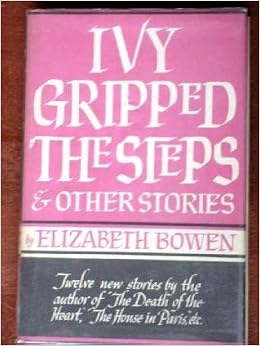
Bowen is a writer who makes the reader dig tenaciously into her syntax to discover the complex human motivations that lie beneath the surface behaviours of her protagonists. “…he had the experience of seeing straight up into eyes that did not see him. Her look was pitched into space”. Here the child protagonist memorably recalls his own invisibility and (his idol) Mrs Nicholson’s ever absent presence in his life and affection. The boy Gavin, desperately ” cast the too-light flowers outwards onto the air” in an attempt to capture Mrs Nicholson’s attention, but this is a doomed enterprise. The ironic femininity and old fashioned courtliness of Gavin’s gesture marks him out as a lonely figure,doomed to be the reluctant, yet naive observer of Mrs Nicholson’s romantic games with the Admiral. The Admiral treats the awestruck Gavin with “co-equal masculine brusqueness” and the knottiness of this summary seems typical of Bowen’s exacting, psychologically revealing expression. The Admiral’s attraction to Mrs Nicholson brings him no rest, or happiness, again a recognition Bowen intensely identifies through ” the abrupt extraction of one hand, for the purpose of clicking thumb and finger together. ” The Admiral is impatient for a cathartic moment which never arrives. Gavin’s jealousy filters the Admiral’s casually polite endearment, ‘my dear’ out of the adults’ conversation and this contrast between the young boy’s desire for Mrs Nicholson ‘s attention with that of the Admiral, (married to a sickly wife), reminds me a little of L.P Hartley’s The Go-between and James’ What Maisie Knew and The Turn of the Screw.

When Mrs Nicholson falls out with the Admiral over his wife, Gavin rightly recognises that ” you meant to make him angry,didn’t you?” But is clearly out of his depth with her subtly hurt yet predatory ” if people….give a party for no other reason but to show off their marriage, what kind of evening can one expect?”The story is like looking through a frosted window onto a world that shows itself as much through glimpsed shadows as any concrete image. It transports us into the vulnerable world of a child’s lonely and frequently disappointed perception, where his adoring compliments feed Mrs Nicholson’s need for flattery because her lover is married to a woman who should ” get better or die”. ( A telling allusion to Wilde’s Lady Bracknell on Bunbury, making explicit Mrs Nicholson intolerant heartlessness, as well as her seemingly convenient belief in Gavin’s latent homosexuality).

The story ends with the adult Gavin attempting to connect with a young woman now stationed in the Admiral’s old house. The young woman rightly recognises that Gavin had ” the face of somebody dead who was still there.” Gavin’s association with the house of Mrs Nicholson has choked his potential for life. Gavin has become “wolfish, a preyer.” Yet the brilliance of Bowen is that she delivers something still more difficult and even indecipherable for the reader to ponder about the whole mess of the association. ” But who had said, preyers are preyed upon?”
Mrs Nicholson’s deadly dismissal of the young boy’s adulation as being like that of a ” little dog,” taints his whole life and future romantic behaviours. Gavin’s life long desire for revenge on women originates with Mrs Nicholson’s own lonely need for compensatory flattery and attention. The grotesque distortion of the room’s shape as “elongated”, when he first hears explicitly, his lowly tangential role in Mrs Nicholson’s life, serves as a cruelly misshapen metaphor for the rest of Gavin’s existence. Lonely rage has supplanted love: desire has supplanted tenderness. Preyed upon has become preyer, an irony all the more tragic if Gavin’s real objects of desire should have been male, but have become forgotten in his displacing behaviours, all compensating for the rejection by someone who was again using another human being to compensate.

Mesmerizing in its knowingness of human selfishness and neglectful, narcissistic need.

Excellent brief analysis except the Bracknell connexion seems a leap too far. If Bowen had had the slightest interest in portraying Gavin as incipiently gay, she would have made that indisputably clear.
Glad you enjoyed. I would have thought that if ‘incipiently gay’ then Bowen would have written ambiguously? And no writer is ever fully aware of all the undercurrents created?