Now, it is a fact, that there was nothing at all particular about the knocker on the door, except that it was very large. It is also a fact, that Scrooge had seen it, night and morning, during his whole residence in that place; also that Scrooge had as little of what is called fancy about him as any man in the city of London, even including — which is a bold word — the corporation, aldermen, and livery. Let it also be borne in mind that Scrooge had not bestowed one thought on Marley, since his last mention of his seven years’ dead partner that afternoon. And then let any man explain to me, if he can, how it happened that Scrooge, having his key in the lock of the door, saw in the knocker, without its undergoing any intermediate process of change — not a knocker, but Marley’s face.
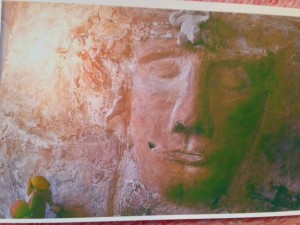
Marley’s face. It was not in impenetrable shadow as the other objects in the yard were, but had a dismal light about it, like a bad lobster in a dark cellar. It was not angry or ferocious, but looked at Scrooge as Marley used to look: with ghostly spectacles turned up on its ghostly forehead. The hair was curiously stirred, as if by breath or hot air; and, though the eyes were wide open, they were perfectly motionless. That, and its livid colour, made it horrible; but its horror seemed to be in spite of the face and beyond its control, rather than a part or its own expression.
As Scrooge looked fixedly at this phenomenon, it was a knocker again.
To say that he was not startled, or that his blood was not conscious of a terrible sensation to which it had been a stranger from infancy, would be untrue. But he put his hand upon the key he had relinquished, turned it sturdily, walked in, and lighted his candle.

Many years ago I remember asking a GCSE student what they found interesting about a passage of writing. The student paused and then smiled saying, ‘to be honest, I don’t find anything particularly interesting at all in English. ‘ The honesty was disarming and made me rethink my question. I dropped my assumptions. ‘What do you find strange about the passage.’
The student launched into a discussion straight away. and since then I have never trusted the word ‘interesting’ in fact sometimes, I ban it from discussions as it encourages surface thinking and vagueness. When we try to find another word instead of interesting, we are forced to think about what we really mean. Here are some examples of the strange on the blog.
So when I was rereading the First Stave of A Christmas Carol, the lobster simile leapt out and demanded to be discussed. It’s a wonderfully strange image and reveals Dickens’ surreal imagination. He ‘knows’ things intuitively and creatively they work!
Here’s a quick worksheet on the strange lobster!
A Christmas Carol: Marley and the ‘Bad Lobster in a Dark Cellar.’
In Stave One Scrooge meets his dead partner, Jacob Marley, once again. In this manifestation, Marley who was ‘dead to begin with’, is now transformed into a doorknob and then is likened to a ‘lobster in a dark cellar.’ When I was reading the novella, I laughed aloud at the surreal simile used to describe the appearance of the ghostly Marley. It seems intuitively brilliant and forces the reader into a very active, imaginative engagement with the story.
‘Marley’s face. It was not in impenetrable shadow as the other objects in the yard were, but had a dismal light about it, like a bad lobster in a dark cellar.’
There is a surreal, spontaneous intelligence about this choice of simile. The image generated is at once humorous and grotesque. It feels as if the lobster is glowing with ill health! And this reflects the terrible purgatory endured by the wandering ghost of Marley whose inability to rest and find peace, is his punishment for his unremitting selfishness in life.
How would you write about the effect of the simile/image on you?
- Is the image surprising? Why? Does it seem random and unusual or strange? Unhealthy?
- Does it force you as a reader to think?
- Is the lobster an unsettling or startling choice of image as it compares a human to a crustacean creature?
- Do comparisons have to make sense? Can we understand something imaginatively more easily when we ‘see’ it? Why?
- Do you take pleasure in being surprised? Is the image uncomfortable in any way?
- If the ‘lobster’ is ‘bad’ due to his decay, then explain the relevance of decay to Marley?
- Is the activity of the dead in the novella at all ironic as Scrooge is so locked in his frozen, repetitive life as a miser that he is more dead than the dead? Decay is, after all, an active, necessary process.
- Is this is a resurrection story?