
How can you ensure that your Creative Writing gains the highest marks possible? Here are five important components of a successful answer to Question Five on Language Paper One.
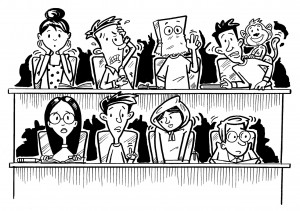
- Make your writing compelling. This means make it interesting to read. I am not suggesting you have to write the most amazing plot for your story. But you do have to write a polished answer for a GCSE English Examination. And I have always advocated the recycling of a strong emotion experienced by yourself being reworked into your story. This guarantees you are writing powerfully and naturally. Learn a few successful plots or one ‘plastic plot’ before you go into your exam. Questions on the GCSE paper are always open and generically flexible.
- Your story requires sophisticated vocabulary. Think about your favourite words and see how you can substitute more ambitious words in their place. If you are short on time, then learn ONE replacement for each word you regularly utilise. Use at least TWO sophisticated words in each paragraph. For example; sad/melancholy/morose/dismal/bleak/emotionally derelict, happy/exuberant/jubilant/ecstatic/delirious, good/benevolent/virtuous/untainted, small/diminutive/miniscule, angry/incandescent/indignant/ incendiary/ enraged/impassioned/ exasperated, evil/heinous/malign/malevolent etc
- Your story requires varied language techniques to enhance the quality of your writing. Endeavour to use two/three techniques per paragraph. Vary these techniques to demonstrate your skills clearly to the examiners. Alliteration/Metaphor/ Pathetic Fallacy/ Foreshadowing/Simile/Oxymoron/Hyperbole/Juxtaposition/ Onomatopoeia/ Tricolon/Personification/Repetition
- Your story also requires a range of punctuation. So please vary your punctuation in every paragraph to demonstrate your writing skills. For example; semi-colons, colons, exclamation marks, questions marks, ellipsis, brackets. Ensure you try at least ONE different form of interesting punctuation per paragraph.
- Finally, ensure you employ different structural devices too. Think about using at least TWO single sentence paragraphs in your story and at least ONE single word sentence. Try not to leave these until the last moment then it does not look as if you have run out of time. For example; single sentence paragraphs/ long sentence paragraphs/ single word sentences/ dialogue/ cyclical structure/flashback.
To summarise once again.
Your story requires a compelling narrative composed of a sophisticated vocabulary, varied punctuation, varied structural devices and the powerful use of language techniques. Make sure each paragraph(excepting one-sentence paragraphs!) contains at least two of each of these ingredients.

Example One Setting: Notice how the language choices are varied yet sustained to create a certain atmosphere and expectation. Notice also the structural devices employed that move the reader from the outside world to the inside and then to the thoughts of a character.
The view from the narrow window was dreary and inexpressibly lonely. Miles of neglected park-land stretched in an unbroken plain to the horizon and the sea beyond. On all sides it was the same.
The grey-green stretches were hayed once a year, perhaps, but otherwise uncropped save by the herd of heavy-shouldered black cattle who wandered about them, their huge forms immense and grotesque in the fast-thickening twilight.
In the centre of this desolation, standing in a thousand acres of its own land, was the mansion, Black Dudley; a great grey building, bare and ugly as a fortress. No creepers hid its nakedness, and the long narrow windows were dark-curtained and uninviting.
The man in the old-fashioned bedroom turned away from the window and went on with his dressing.
‘Gloomy old place,’ he remarked to his reflection in the mirror. ‘Thank God it’s not mine.’
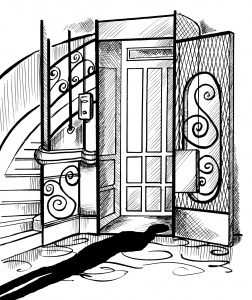
Example Two-Character: The First Person Narrator Leaks Information that is Psychologically compelling. Look how the metaphorical descriptions of intimacy generate a palpable sense of unease as well as underlining the speaker’s unhealthy sense of superiority.
“I never let anything tear the skin. I’ve never been faintly fond of anything or of anybody in my life.” He spoke lightly but with satisfaction. “I’m deadly serious about this. I spotted the plain mechanical truth of it as a child. .. Any kind of affection is a solvent. It melts and adulterates the subject and by indulging it he loses his identity and hence his efficiency. By keeping myself to myself in the face of every conceivable attack I have remained successful, bright, and indestructible. It’s a simple recipe for a hundred per cent success…”

Example Three: Setting, Characterisation, Sentence structure and Punctuation. See how the sense of the sinister boat’s meandering quest is evoked in the first paragraph through the long, one-sentence paragraph. Then pay attention to the way the semi-colons give an uncomfortably claustrophobic sense of connection between the father and daughter in the boat. Notice too, the tantalising, yet dismal use of the list, the bewildering, enigmatic effect of the repeated negatives and the finale which explores the effect of the river’s monstrous personification on the young girl.
In these times of ours, though concerning the exact year there is no
need to be precise, a boat of dirty and disreputable appearance,
with two figures in it, floated on the Thames, between Southwark
bridge which is of iron, and London Bridge which is of stone, as an
autumn evening was closing in.
The figures in this boat were those of a strong man with ragged
grizzled hair and a sun-browned face, and a dark girl of nineteen or
twenty, sufficiently like him to be recognizable as his daughter.
The girl rowed, pulling a pair of sculls very easily; the man, with
the rudder-lines slack in his hands, and his hands loose in his
waistband, kept an eager look out. He had no net, hook, or line,
and he could not be a fisherman; his boat had no cushion for a
sitter, no paint, no inscription, no appliance beyond a rusty
boathook and a coil of rope, and he could not be a waterman; his
boat was too crazy and too small to take in cargo for delivery, and
he could not be a lighterman or river-carrier; there was no clue to
what he looked for, but he looked for something, with a most intent
and searching gaze. The tide, which had turned an hour before,
was running down, and his eyes watched every little race and eddy
in its broad sweep, as the boat made slight head-way against it, or
drove stern foremost before it, according as he directed his
daughter by a movement of his head. She watched his face as
earnestly as he watched the river. But, in the intensity of her look
there was a touch of dread or horror.
