

Poor Winterbourne was amused, perplexed, and decidedly charmed. He had never yet heard a young girl express herself in just this fashion; never, at least, save in cases where to say such things seemed a kind of demonstrative evidence of a certain laxity of deportment. And yet was he to accuse Miss Daisy Miller of actual or potential inconduite, as they said at Geneva? He felt that he had lived at Geneva so long that he had lost a good deal; he had become dishabituated to the American tone. Never, indeed, since he had grown old enough to appreciate things, had he encountered a young American girl of so pronounced a type as this. Certainly she was very charming; but how deucedly sociable! Was she simply a pretty girl from New York State- were they all like that, the pretty girls who had a good deal of gentlemen’s society? Or was she also a designing, an audacious, an unscrupulous young person? Winterbourne had lost his instinct in this matter, and his reason could not help him. Miss Daisy Miller looked extremely innocent. Some people had told him that, after all, American girls were exceedingly innocent; and others had told him that, after all, they were not. He was inclined to think Miss Daisy Miller was a flirt- a pretty American flirt. He had never, as yet, had any relations with young ladies of this category. He had known, here in Europe, two or three women- persons older than Miss Daisy Miller, and provided, for respectability’s sake, with husbands- who were great coquettes- dangerous, terrible women, with whom one’s relations were liable to take a serious turn. But this young girl was not a coquette in that sense; she was very unsophisticated; she was only a pretty American flirt. Winterbourne was almost grateful for having found the formula that applied to Miss Daisy Miller. He leaned back in his seat; he remarked to himself that she had the most charming nose he had ever seen; he wondered what were the regular conditions and limitations of one’s intercourse with a pretty American flirt. It presently became apparent that he was on the way to learn.
‘Have you been to that old castle?’ asked the young girl, pointing with her parasol to the far-gleaming walls of the Chateau de Chillon.
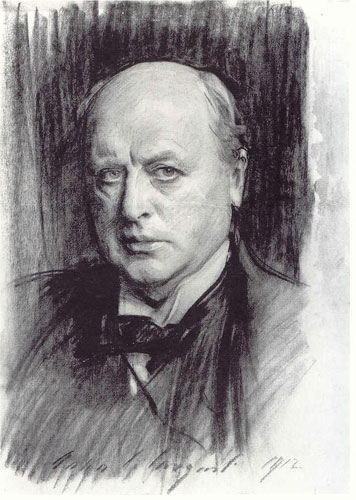
I have always had an awkward relationship with Henry James. A tutor once told me to read his last novel The Golden Bowl as it would change my life. I managed a third of its tortuously convoluted prose and decided my life would have to stay as it was. I wanted narrative passion and energy: James seemed to be offering high aestheticsm as a prolonged substitute for existence Whilst I would never claim to be a Jamesian, nowadays I do find I enjoy the stately progression of his sentences rather more than I used to…though there remains an unease about his overly subtle differentiations between one moral choice and another that lingers!
Just do it I think at times. Take a risk. Try that what if…we may only live once!
If I had a visual image of a Jamesian novel it would be of a drawing room with people gazing at each other curiously across the linen napkins but never daring to meet each other in any authentic way at all.
The story of Daisy Miller is one of my favourite of James’s tales and like so many Nineteenth Century novels depends for its narratorial life-blood on a male voice who is almost superfluous to his own existence. ( Think of of Pushkin’s Eugene Onegin, Lermontov’s A Hero Of Our Time, the whole of Chekhov and even Hardy’s Jude ) This narrative investment in a largely impotent figure serves to reveal the deep seated stasis in much social interaction and is psychologically acute and uncomfortable.
Winterbourne is the protagonist and ‘filters’ through his impressions of the heroine Daisy Miller so that we never see Daisy except through the qualifying prose of Winterbourne himself. Thus by the end of the tale, we feel we have not met Daisy at all. We have only caught glimpses of this transient ‘flower’ almost in spite of the suffocating prevarications of Winterbourne’s ‘frozen’ eye! We feel thwarted by the elusiveness of this heroine!
If we look at this extract from Daisy Miller we see Winterbourne trying to make up his mind about this new acquaintance, this new ‘word’ in his highly bounded existence. He clearly feels unsettled by ambiguity and the we notice James’s protagonist processing and reprocesssing a ‘list’ of judgements and values. These shards of possible values inhibit the possibility( and probability) of action and place a keen emphasis upon the moral ‘inscape’ of the character under scrutiny. And this scrutiny ironically seems to focus rather more explicitly upon Winterbourne than Daisy herself. whose freshness is acknowledged but then denigrated.
When Winterbourne signficantly leans back in his seat to observe Daisy then we know he is never going to allow himself to fall in love. She is a specimen to him and the displaced American society he represents. Daisy by contast is ensnared within the net of his second hand moral judgements and he has not the will or the courage to allow her her own voice and presence.
The register we use when we describe others ( and ourselves) is of course highly revealing. No one understood this better than James to whom displacement was life. In this extract we sense a male in retreat. He longs to be led ‘astray’ yet spends his time ascertaining again and again just how near the right path he actually is. Winterbourne’s gaze uncovers his sexual interest whilst also acting as a substitue ( through spectatorship) for the real thing.
Little wonder that James’s prose induces a sense of somnolent claustrophobia at times!
When poor Daisy defies all conventions in Rome and visits the Colosseuem at night, she is enveloped in a ‘villainous miasma’ and contracts malaria and dies. The scene in the Colosseum is one of the best in James and plays upon Rome’s association with ‘chiaroscuro’ ( light and dark) as Winterbourne tries to negotiate the ambivalent shades of Daisy’s final meaning in Rome.
Her death ironically brings out the absolute confirmation of her much debated innocence and I can’t help feeling that Henry James’s tragic heroine dies as much as the outcome of her author’s sexual anxiety (and ambivalence) , as from malaria itself. Not an unusual fate of course for a spirited female in Nineteenth Century Fiction! ( Comprehension usually signfies death in James: think of The Turn of the Screw and The Beast in the Jungle for example..)
‘What sort of space is that which separates a man from his fellows and makes him solitary ?’ ( Thoreau)
Henry James knew this space only too well!