
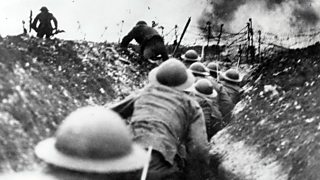
Our brains ache, in the merciless iced east winds that knive us . . .Wearied we keep awake because the night is silent . . .Low drooping flares confuse our memory of the salient . . .Worried by silence, sentries whisper, curious, nervous,But nothing happens.Watching, we hear the mad gusts tugging on the wire,Like twitching agonies of men among its brambles.Northward, incessantly, the flickering gunnery rumbles,Far off, like a dull rumour of some other war.What are we doing here?The poignant misery of dawn begins to grow . . .We only know war lasts, rain soaks, and clouds sag stormy.Dawn massing in the east her melancholy armyAttacks once more in ranks on shivering ranks of grey,But nothing happens.Sudden successive flights of bullets streak the silence.Less deadly than the air that shudders black with snow,With sidelong flowing flakes that flock, pause, and renew,We watch them wandering up and down the wind’s nonchalance,But nothing happens.Pale flakes with fingering stealth come feeling for our faces—We cringe in holes, back on forgotten dreams, and stare, snow-dazed,Deep into grassier ditches. So we drowse, sun-dozed,Littered with blossoms trickling where the blackbird fusses.—Is it that we are dying?Slowly our ghosts drag home: glimpsing the sunk fires, glozedWith crusted dark-red jewels; crickets jingle there;For hours the innocent mice rejoice: the house is theirs;Shutters and doors, all closed: on us the doors are closed,—We turn back to our dying.Since we believe not otherwise can kind fires burn;Now ever suns smile true on child, or field, or fruit.For God’s invincible spring our love is made afraid;Therefore, not loath, we lie out here; therefore were born,For love of God seems dying.Tonight, this frost will fasten on this mud and us,Shrivelling many hands, and puckering foreheads crisp.The burying-party, picks and shovels in shaking grasp,Pause over half-known faces. All their eyes are ice,But nothing happens.Exposure is a sombre, profoundly poignant poem which explores the poet’s two days’ ‘exposure’ to the twin enemies of winter and warfare in 1917. Owen’s animation of the elements through the use of personification , gives the poem an almost surreal atmosphere, revealing the hallucinatory experiences of soldiers literally at the end of their tether. The men are frozen, abject with fear and feel God( if there is one) has deserted them.I will go through the poem stanza by stanza offering a brief analysis of each one. Here is my first analysis:Our brains ache, in the merciless iced east winds that knive us . . .Wearied we keep awake because the night is silent . . .Low drooping flares confuse our memory of the salient . . .Worried by silence, sentries whisper, curious, nervous,But nothing happens.The opening of Exposure reveals Owen’s ‘exposure’ to the poet Keats, who was his hero and major influence. The phrase, ‘ Our brains ache’ recalls the opening to Keats’ famous poem Ode to a Nightingale(1819)where Keats says: ‘My heart aches, and a drowsy numbness pains My sense, as though of hemlock I had drunk’.Keats’ poem explores the way the sublime song of the nightingale, transports the poet away from the harsh realities of the present and into a realm of near ecstasy and oblivion. Keats suggests that it might be preferable to die when one is enjoying a beautiful vision(auditory in this case) rather than becoming afflicted by the many diseases and grim realities of life.In Owen’s poem, the sublime has become supplanted by an all too debilitating reality at the front, that affects the mind as much as the body. The animation of the wintry ‘iced east winds’ makes them seem predatory and violently disposed to murder. The use of the pronouns ‘us’ and ‘our’, engenders a strong sense of community and comradeship, and of the way the suffering is both intimate and universal at the front. The sibilance in the opening line, gives the wind a voice and character that is insinuating and sinister. The wind is everywhere and is an immediate and all too real enemy. Heartless nature is even attacking the beleaguered men. The men feel abject and alone: ‘exposed’ to a nightmarish reality where the only relief seems to be death. Insomnia is prevalent despite the exhaustion: ‘Wearied we keep awake.’ Vigilance is ironic because the enemy is as much the ‘natural’ weather as the ‘unnatural’ war. What are the men awake to?The irony is heightened by the admission that the poet and his men distrust the fact that ‘ the night is silent.‘ Silence is neither peaceful nor does it offer any respite. It has been usurped by military machination and secret strategy. Silence causes anxiety, as it is linked to secrecy and the deceit of the enemy soldiers. There is also an irony that the carol ‘silent night'( sung during the Christmas Truce of 1914) has now become rewritten as a declaration(and source) of anxiety: ‘ the night is silent.‘ The alliterative ‘w’ once again draws together the men like the pronouns in the first line, revealing the communal experience of the men and the lack of differentiation in their suffering.The third line explores the effect of the ‘low drooping flares.’ Light seems hallucinatory and malignant. What can been seen and read safely in such a bleak and antagonistic environment? Suffering and insomnia have made the men disoriented and they can no longer discriminate between the safe and the dangerous. The landscape is not to be trusted. It’s nightmarish.Sibilance is again deployed in the next line where the investment in ‘s’ sounds draw out the soft murmurs of the watchful soldiers, who are trying to make sense of their competing interpretations of the encroaching silence. Once again, sibilance delivers an underlying sense of unease. Something deadly is about to happen.But then the refrain and half line: ‘But nothing happens.‘ Are the soldiers overreacting or is their anxiety going to be drawn out for even longer? Is the line ironical because lots is happening that the men cannot percieve, because they are mere puppets? The line seems to me cynically bathetic, as if the absent gods are toying with the souls of the soldiers, who have nothing to look forward to except hypothermia, injury and death. ‘Nothing’ is made a relative term and seems an existential nightmare; a place of oblivion.To be continued!



What a brilliant poem by Owen. Your resonse to its emotional gravity is exceptionally thoughtful, wonderfully well-expressed and emotionally literate. This reminds me why
I wanted to study little rature in tbe first place!