
I’ve just finished reading Patricia Highsmith’s Strangers on a Train, Highsmith’s famous tale of two travellers who discuss the possibility of murdering each other’s “problems” in entirely isolated incidents that would escape detection. Murder has thus become a matter of trade or exchange, where killers are proteced by their apparent lack of motive.
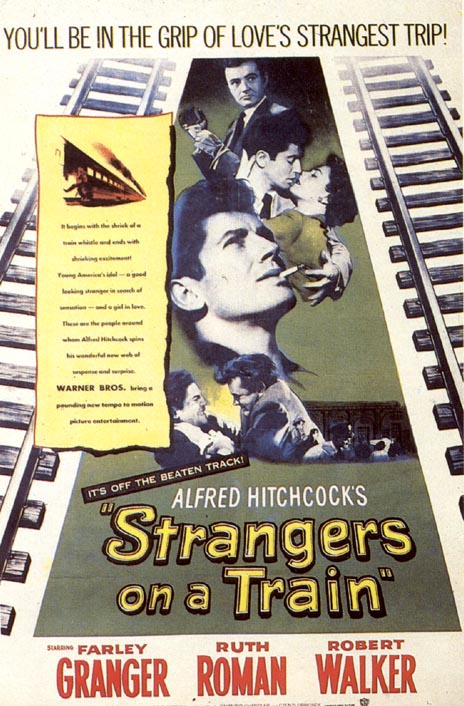
The narrative is filtered through the viewpoints of the two protagonists Guy and Bruno who find each other alternately repulsive and attractive. It is a macabre dance of death with the fairground murder scene of Guy’s wife Miriam proving particularly grotesque.
Like Dostoevsky and Robert Louis Stevenson, Highsmith is fascinated by the idea of the doppelganger. The gradual absorption of the apparently “good” character of Guy, within the psyche of the Faustian villain Bruno, develops with a terrible momentum and chilling inevitability. Guy’s “sane” consciousness progressively mimics Bruno’s disintegrating mind. The strange mingles with the common place and the narrative escalates into a nightmarish whirlpool of contradictory desires. This predilection for the strange seems a signature of Highsmith’s work- she is an excavator of human perversity in the sense that we contradict ourselves even when we appear most self-aware and resolute.

Here’s a beautifully disturbing moment of recognition filtered through Guy’s consciousness during the closing stages of the novel:
“Automatically, as he rounded the corner of the parker lot, his eye fell on Bruno’s long, bright blue convertible. The merry-go-round horse Bruno had ridden on, Guy remembered Bruno saying, had been royal blue, and that was why he had bought the car. He saw Bruno standing under the shed of the dockhouse,saw everything of him except his head, the long black overcoat and the small shoes…”

Bruno is so eager to impress Guy with his purchase, that he cannot resist his narcissistic need to taunt Guy with the colour of the car. Surely Bruno is more than a little deranged in his constant craving for attention? Yet we also recognise the symbiotic attachment and ‘recognition’ between observer and the observed. Guy understands Bruno, because part of him IS Bruno and vice versa. I sensed that the whole attraction depends upon unresolved sexuality, so that their intimacy shifts between repulsion and fascination. Guy purports to loathe Bruno, yet imagines him everywhere. Even in locked rooms!
I found this moment above arresting as I believed it. I felt it chillingly RIGHT. For Bruno would parade his violent victory through the terrible intimacy of this royal blue sign to Guy and the world beyond. It felt as if Highsmith’s understanding of Bruno’s craving for love and recognition coalesces in this image. It seems both childishly and chillingly perfect. I found the ‘headless’ glimpse of Bruno imaginatively revealing too. Why does Guy ‘see’ a headless Bruno? Does it create a metonymical displacement between the body and mind of Bruno? The headlessness makes Guy IMAGINE the SECRET motivation of Bruno. And so Guy IMAGINES what lies in Bruno’s head/mind. The use of metonymy heightend the alienation effect and reveals the disentagration of Guy’s orderly, coherent world.
I love the throwaway ‘small shoes’…and not sure if this makes Bruno’s appearance tenderly grotesque…diminutive feet…vulnerable psychopathy?!! Now that would be oxymoronic and worthy of Highsmith’s looming awareness of love under the stone of repression..Katherine Mansfield’s ‘snail under the leaf’ comes to mind too.
Aren’t lovers greedy readers of signs- voraciously trying to decipher the hidden language of longing and despair?
Guy finds Bruno irresistible , in ways he daren’t admit until the climatic drowning scene, where Bruno’s suicide brings Guy’s crazed need of his ‘partner’ out into a very watery open! ?
Bruno’s Oediphal dependency upon his mother,his physical loathing of his father and his lack of any romantic interest in women make his need for Guy’s affection pronounced. His unspoken homosexuality becomes sublimated into alcohol and violence. Bruno’s erratic behaviour terrifies Guy yet on some deep level connects with him too. Bruno offers Guy a dangerous intimacy that hijacks his entire existence fulfilling a need for the extraordinary that Guy has buried deeply within his “achiever” , ” decent” pysche.“I’ve known Guy all his life, “he said softly, menacingly. “Ask him.”
How compelling is this blatantly needy lie that proves so psychologically and fatally true? Bruno has hijacked Guy’s time line, so that Guy’s history is no longer his own. Bruno- the- Faustian historian has taken possession…
In some ways the novel seems like a Shakespearean tragedy. Bruno’s jealousy and possessiveness resembles that of Othello and his nemesis Iago. Thus, Bruno’s reediting of his intimacy with Guy is not a question. It is a statement of diabolical propinquity.
Brilliant!

‘Aren’t lovers greedy readers of signs- voraciously trying to decipher the hidden language of longing and despair? ‘
That’s pretty brilliant itself! I only know the film, but your excellent reading of the novel definitely makes me want to take a look . Jill M.