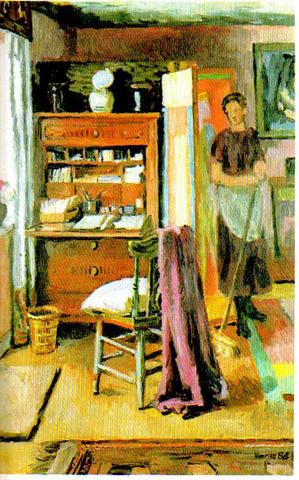
Je ne parle pas Francais
After that I took Dick about with me everywhere, and he came to my flat, and sat in the armchair, very indolent, playing with the paper-knife. I cannot think why his indolence and dreaminess always gave me the impression he had been to sea. And all his leisurely slow ways seemed to be allowing for the movement of the ship. This impression was so strong that often when we were together and he got up and left a little woman just when she did not expect him to get up and leave her, but quite the contrary, I would explain: “He can’t help it, Baby. He has to go back to his ship.” And I believed it far more than she did.
All the while we were together Dick never went with a woman. I sometimes wondered whether he wasn’t completely innocent. Why didn’t I ask him? Because I never did ask him anything about himself. But late one night he took out his pocket-book and a photograph dropped out of it. I picked it up and glanced at it before I gave it to him. It was of a woman. Not quite young. Dark, handsome, wild-looking, but so full in every line of a kind of haggard pride that even if Dick had not stretched out so quickly I wouldn’t have looked longer.
“Out of my sight, you little perfumed fox-terrier of a Frenchman,” said she.
(In my very worst moments my nose reminds me of a fox-terrier’s.)
“That is my Mother,” said Dick, putting up the pocket-book.
But if he had not been Dick I should have been tempted to cross myself, just for fun.
A Married Man’s StoryIt is evening. Supper is over. We have left the small, cold dining room; we have come back to the sitting room where there is a fire.All is as usual. I am sitting at my writing table which is placed across a corner so that I am behind it, as it were, and facing the room. The lamp with the green shade is alight; I have before me two large books of reference, both open, a pile of papers. … All the paraphernalia, in fact, of an extremely occupied man. My wife, with our little boy on her lap, is in a low chair before the fire. She is about to put him to bed before she clears away the dishes and piles them up in the kitchen for the servant girl to-morrow morning. But the warmth, the quiet, and the sleepy baby have made her dreamy. One of his red woollen boots is off; one is on. She sits, bent forward, clasping the little bare foot, staringA into the glow, and as the fire quickens, falls, flares again, her shadow – an immense Mother and Child – is here and gone again upon the wall..
Who can survive a first person narrative unblemished? Does the use of a first person narrator encourage a form of self persecution? Or is this urge to confess, just a device for self glorification and indulgence?
Here, in the two stories above, Mansfield reveals the character of her narrators through their progressively disquieting disclosures. Neither Raoul Duquette in Je ne parle pas francais, nor the unnamed narrator in A Married Man’s Story avoid the reader’s negative judgement, for both narrators seem alienated and alienating, proud of their misogyny, without compassion for their victims.
Thus the use of the first person narrator forces us to share narrative intimacy with voices whose view of relationships seems rather macabre.Confessional narratives without guilt, where confession is a form of pleasure for the speaker?
These two tales seem amongst the most brilliant of Mansfield stories, not least because of their dark comic tone. We cannot resist the insinuating, stylised weariness that ensnares us through witticism and unnerving revelation.
Ennui masking God knows what? I do like to wonder about which actor I think would suit the voice(s) .
John Malkovich for insinuating sinister? Antony Hopkins? James Mason? Even Ralph Fiennes who gorgeously camp yet warm in The Grand Hotel Budapest.
Look at the disassociation achieved in A Married Man’s Story through the use of the pronouns concerning the speaker’s wife and child. He regards them as objects and though he elevates them to a sort of Virgin and Child (Pieta) of the night’s shadows, we feel a coldness and separation that suggests alienation and even repulsion.
Even the furniture acts as a barrier between the first person narrator and the family. The staccato tone is a sinister pulse to the tale. This is a heartless story as we sense the sterility of the family and the sexual ambivalence of the speaker, trapped inside a conventional relationship.
Duquette’s prancing tone and playful sexual fascination with his friend is neatly summarized in his jokey identification with the perfumed fox terrier…Duquette’s narcissistic glee is lazily destructive and malicious. Words are his bait, and the tale reveals the tragedy of the ‘mouse’ woman/girl who becomes trapped within his web.
Both stories are drenched in a studiedly world weary tone that only requires a packet of Gitanes or Gauloises to complete the scene!