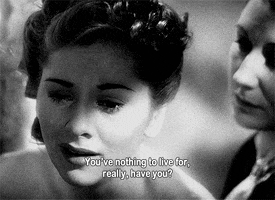
‘Go on,’ whispered Mrs Danvers. ‘Go on, don’t be afraid.’
I shut my eyes. I was giddy from staring down at the terrace, and my fingers
ached from holding to the ledge. The mist entered my nostrils and lay
upon my lips rank and sour. It was stifling, like a blanket, like an
anaesthetic. I was beginning to forget about being unhappy, and about
loving Maxim. I was beginning to forget Rebecca. Soon I would not have
to think about Rebecca any more ..
{Here’s a wonderful moment in Rebecca where Du Maurier reveals her skills as a writer of intense drama and pyschological suspense. GCSE and GCE Students have enjoyed exploring Rebecca and find her writing compelling, easy to see why}.
Verbs matter. Verbs transport your readers. Look at the effect of ‘whispered’ in the passage above. The verb gives a confidential even conspiratorial tone to the repeated ‘Go on.’ We can hear the soft, cajoling encouragement of ‘go on‘ because Mrs Danvers is close enough to her victim(the first person narrator) to whisper. The unsettling proximity of the house keeper is established through the use of the verb, ‘whispered.’ Mrs Danvers is breathing her poison into the narrator’s ear: offering a deadly reassurance: ‘don’t be afraid.‘ A Judas kiss of a whisper.
‘Whispered’ also resonates with sibilance. You can hear the ‘s’ sounds and it sounds in this context creepily intimate, snake-like, almost sexually insinuating. It feels as if Mrs Danvers is behaving as a temptress, yet her austere appearance denies this. However the twist is to remember that she is behaving as Rebecca. Maybe she is even being Rebecca. Consequently, Mrs Danvers is on a seductive holiday from herself. Her language(which she believes is Rebecca’s) is FALLEN!
In Gothic writing, hierarchies are upset. Mental, physical and psychical boundaries are destabilised. The confidante here, is a dangerous, surreptitious assassin. Perhaps Mrs Danvers believes she is now Rebecca herself. She is familiar enough with her dead mistresses voice to perform her desires(or so she thinks?) For Rebecca is Mrs Danvers’ barely secret obsession.
If Mrs Danvers is being ‘Rebecca’, then she performs ‘ Rebecca’, seductive; powerful; potent. Mrs Danvers is ventriloquising Rebecca’s voice in the way that infatuated lovers often do. Being Rebecca for Mrs Danvers seems the ultimate homage to her dead mistress. She is resurrecting Rebecca by speaking as if she IS Rebecca, so she can dispose of Rebecca’s usurper, the second Mrs De Winter, and restore Manderley to what it was.
The effect of the whisper is palpably apparent.‘ The mist entered my nostrils and lay
upon my lips rank and sour’. We are unsure of what is real and what is imagined. Everything is animated and distorted under the influence of the Gothic impulse.The trance -like state continues, so the narrator admits to disorientation and feels under an ‘anaesthetic’. The narrator is tempted, the ‘whispered’ imperatives are propelling her to the very edge. Yet as I said in my last blog, the final word is still Rebecca’s.’ I was beginning to forget Rebecca. Soon I would not have to think about Rebecca any more .’ What an irony! It is as if Mrs Danvers in ventriloquising Rebecca, has conquered the narrator’s survival instinct. ‘Rebecca’ has claimed her. Mrs Danvers and the second Mrs De Winter are mere cyphers compared to the original Mrs De Winter, Rebecca!
But of course this is not the end, nor is it the end of Rebecca. The fog has brought a ship onto the rocks and below that ship, lies a small boat with the body of a mysterious woman closed inside the cabin…