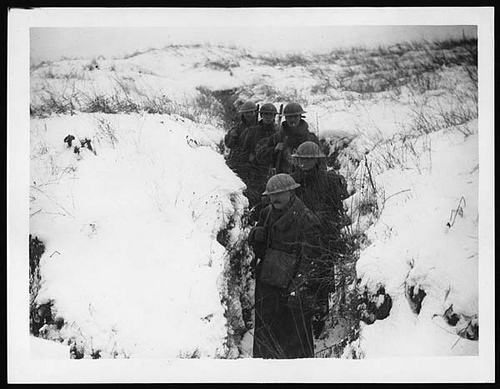
The poignant misery of dawn begins to grow . . .We only know war lasts, rain soaks, and clouds sag stormy.Dawn massing in the east her melancholy armyAttacks once more in ranks on shivering ranks of grey,But nothing happens.Dawn is ordinarily associated with optimism and renewal; even with second chances and forgiveness. Yet Owen’s ‘dawn’ in stanza three is yet another signifier of ‘misery’. Its appearance seems to perpetuate further possibility of suffering. It could even read as nature’s taunting of the men. The advent of dawn brings in further anxiety too about the manner and shape of suffering. Ironically, the verb ‘grow’ is linked to misery, rather than to hope. The use of ellipsis gives space for contemplation and ironic ‘growth’ of the mood and allows the oxymoronic message to sink in, Just like the weather. Owen’s sombre recital of what the soldiers all know, uses the present tense for simplicity. Life has dwindled to such acknowledgements : ‘We only know war lasts , rain soaks, and clouds sag stormy.’ This list collects up what remains of the poet’s energy and suggests a moment by moment series of simple observations. Even the clouds are weary, they ‘sag‘ , ready to collapse like the soldiers who are observing them.Once again the personification of the weather animates the threat such wintry conditions present to the stranded men in no man’s land. The description of ‘dawn massing’ makes nature seem cancerous, and gathering in momentum and power. Obviously the soldiers’ lack of optimism is mirrored directly in the weather. They project their lack of hope onto their surroundings, but then their surroundings are so grim what might seems a projection becomes a gloomy mirror. A nightmarish reality. And then the ironic naming of the ‘melancholy army’ is self evident. The ‘attacks’ by the rain appear almost indistiguishable now from the bullets. Both rain and bullets are destructive and carry the the threat of final annihilation and oblivion. Yet the poem seems to suggest that oblivion might be a welcome release.The recurring short line and refrain, ‘But nothing happens’ mocks the predicament of the soldiers. Their lives have become so accustomed to war’s misery, that now the added misery of the cruel weather, fails to register in the language available. What is this existential ‘nothing’ we wonder from the safety of our warm homes? Owen’s ‘nothing’ is dark despair.And despair is so ever present that it no longer needs to be named except as recurring nullity.