Dracula’s Castle: Jonathan Harker’s First Impressions. ( English Year 7/8)
I stood in silence where I was, for I did not know what to do. Of bell or knocker there was no sign. Through these frowning walls and dark window openings it was not likely that my voice could penetrate. The time I waited seemed endless, and I felt doubts and fears crowding upon me. What sort of place had I come to, and among what kind of people? What sort of grim adventure was it on which I had embarked? Was this a customary incident in the life of a solicitor’s clerk sent out to explain the purchase of a London estate to a foreigner? Solicitor’s clerk! Mina would not like that. Solicitor, for just before leaving London I got word that my examination was successful, and I am now a full-blown solicitor! I began to rub my eyes and pinch myself to see if I were awake. It all seemed like a horrible nightmare to me, and I expected that I should suddenly awake, and find myself at home, with the dawn struggling in through the windows, as I had now and again felt in the morning after a day of overwork. But my flesh answered the pinching test, and my eyes were not to be deceived. I was indeed awake and among the Carpathians. All I could do now was to be patient, and to wait the coming of morning.
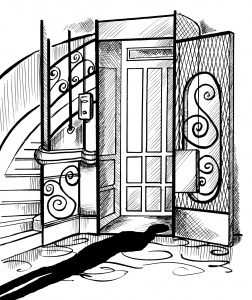
Just as I had come to this conclusion I heard a heavy step approaching behind the great door, and saw through the chinks the gleam of a coming light. Then there was the sound of rattling chains and the clanking of massive bolts drawn back. A key was turned with the loud grating noise of long disuse, and the great door swung back.

- Why does the first person narrator ‘not know what to do’?
The castle appears unwelcoming and even antisocial , as there is ‘no sign’ of either a ‘bell’ or a ‘knocker.’ This suggests the castle is inhospitable and exists outside normal society, actively deterring company. The castle is ‘illegible’ in terms of its accessibility to meaning. A visitor is therefore in an extraordinary situation because they are exceptional and have no idea of the rules governing the place. The narrator is clearly away from home and feels at a loss as to how he should behave. It seems a ‘nightmare’ and of course, it is horrible ‘other’! The rules of this place are unclear, hence the narrator’s palpable lack of understanding. The narrator’s helplessness makes him vulnerable to a predator like Dracula and this will heighten the horror of the story and our protectiveness towards the character of Harker.
- Why does the narrator personify the castle and what does this suggest about his emotional state? ( ‘ …these frowning walls’)
The personification of the castle gives powerful representation to the fear and disorientation of the first person narrator. This directs the reader to sympathise with the young solicitor and to endow the castle with mystery and even a sense of impending incarceration. Emotionally the reader senses that the narrator is feeling intensely vulnerable and exposed. The home of Dracula has taken on the predatory character of its owner. In a sense Dracula and his castle are mirrors of one another.
Whenever a narrator personifies something in his/her world, the animation signifies something emotionally affecting has taken hold of the narrator’s imagination.
The animation of an inanimate object like a building or ‘thing’ often communicates heightened and even ambivalent emotion. In this situation the ‘frowning’ expression is suggestive of disapproval, even condemnation.
- Why does the writer make his narrator( protagonist) a solicitor? How might this affect the story’s mounting horror for the reader?
Solicitors are associated with the law and with rationality and logic. If the protagonist or witness is a legally minded character, then the reader expects rational behaviour. The contrast between the world of the law and the world of Dracula is striking. Our trust in the solicitor heightens our belief in his jeopardy. Fantastical texts often employ this technique where logic is challenged by the supernatural. The natural composure of the young solicitor will be sorely challenged in the narrative and this heightens the horror, as we believe in Harker’s mounting sense of unease, as he is not naturally a fantasist. Harker’s natural hesitation before something extraordinary detonates the reader’s doubt and guarantees a horror-ridden journey through the narrative!
- How do you feel as the key is ‘turned’ and the ‘great door swung back’? Why?
We feel a keen sense of anticipation and apprehension as the threshold that separates Harker from the ( relatively known world) is crossed into a world governed by Dracula and his supernatural followers. It is ironic that the door opening also allows some ‘gleam’ of light to be glimpsed. However, this light is ironically governed entirely by the darkness of Dracula himself. The ‘disuse’ of the door makes us curious as to why Harker is being allowed to cross the threshold. We fear for him! And the ‘heavy step’ of the approaching owner again increases our apprehension. Why is the castle so fortified and unwelcoming? Are the chains to keep the public away or are they also a sign of imprisonment against the human will?