Notes on Stave One with Analysis.
Scrooge never painted out Old Marley’s name. There it stood, years afterwards, above the warehouse door: Scrooge and Marley. The firm was known as Scrooge and Marley. Sometimes people new to the business called Scrooge Scrooge, and sometimes Marley, but he answered to both names. It was all the same to him.
The first sentence appears to confirm the excessive miserliness of Scrooge, as the reader might assume Scrooge cannot envisage any reason to waste money on paint and labour, so he leaves his dead partner’s name above the office door. And we could further develop the omission as a sign of Scrooge’s lack of interest in his dead partner, hence he feels no need to avoid what might appear to be an emotionally sensitive issue if he is mistaken for Marley.
However, it is also possible to relate this omission to Scrooge’s unconsciously unresolved mourning for his only friend. This reading is supported by Marley himself who evidently feels a residual connection to Scrooge as he returns to haunt his friend, warning him of the impending visits of the ghosts, as well as revealing his own dreadful punishment for his life-long meanness.
Hence, when we witness Scrooge’s bantering conversation with Marley, we do observe something of their original affection and recognise that they were important to each other. Despite their mutual avarice, they do show signs of friendship in their actions and conversation. If we follow this reading then the sentence, ‘It was all the same to him’ becomes more of a sign of depression than being simply a sign of emotional indifference or callousness. He does not correct any lack of differentiation of himself from Marley, because the confusion perpetuates Marley’s link to himself wand after all he is as ‘solitary as an oyster’ and has no one else to share any connection with.
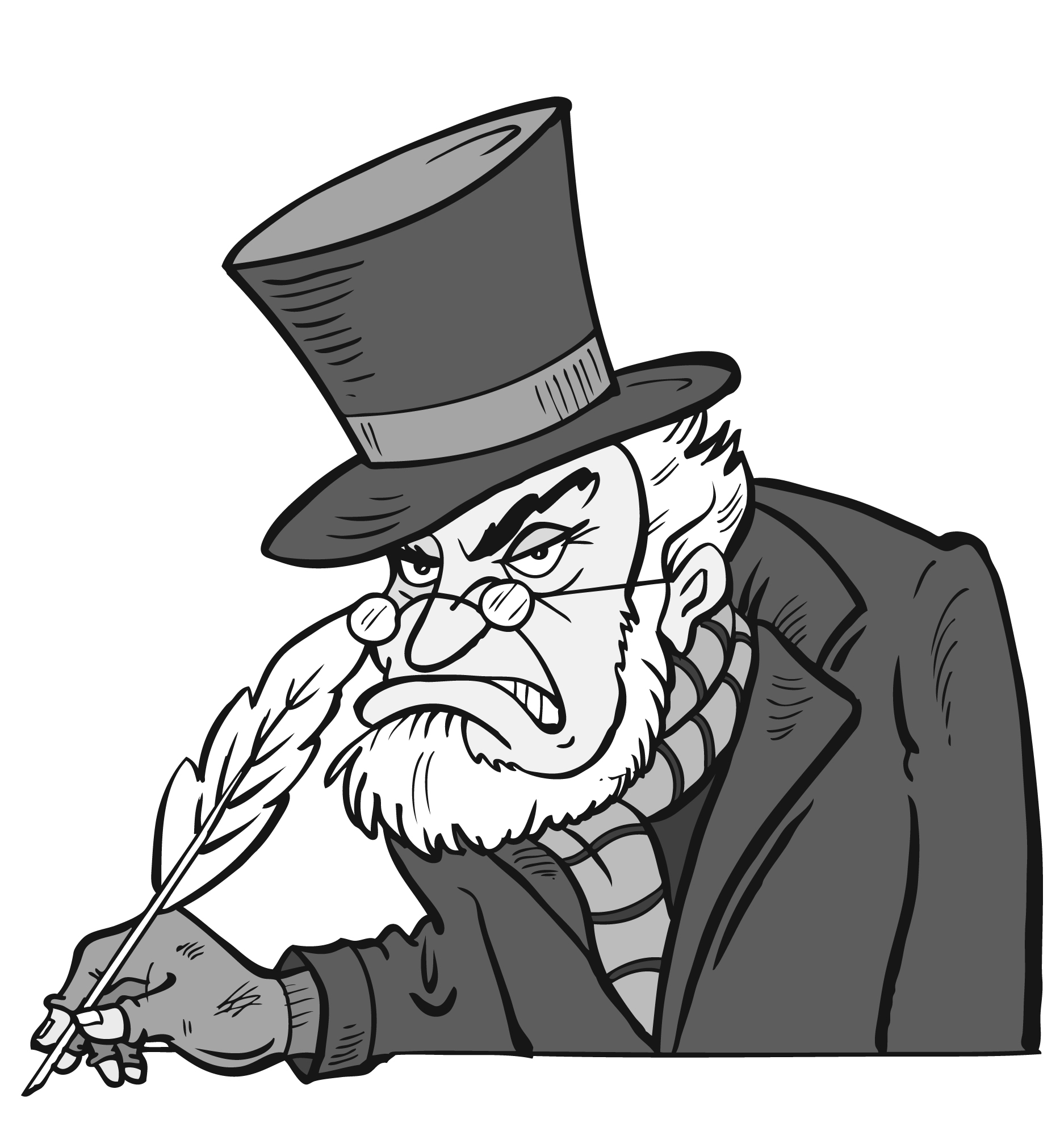
Oh! But he was a tight-fisted hand at the grindstone, Scrooge! a squeezing, wrenching, grasping, scraping, clutching, covetous, old sinner! Hard and sharp as flint, from which no steel had ever struck out generous fire; secret, and self-contained, and solitary as an oyster. The cold within him froze his old features, nipped his pointed nose, shrivelled his cheek, stiffened his gait; made his eyes red, his thin lips blue; and spoke out shrewdly in his grating voice. A frosty rime was on his head, and on his eyebrows, and his wiry chin. He carried his own low temperature always about with him; he iced his office in the dog-days; and didn’t thaw it one degree at Christmas.
The exclamation at the beginning of this description shows a pronounced emotion on the part of the observer. It might suggest excitement as well as wonder and exasperation. The pantomime villainy of Scrooge is communicated through a description of his excessive coldness. The list of adjectives have a cumulative effect , reinforcing his predatory greed which seems is linked to his grip: Scrooge therefore appears a creature of death like a bird of prey- certainly inhuman!
The sibilance ‘solitary as an oyster’ hints at secrecy and reinforces his hardness which we later may recognise is an unhealthy form of self protection in compensation for parental neglect in his childhood. Of course the reader would also recognise that some oysters also contain pearls which are precious and rare. This is again realised later in the novel where Scrooge is transformed and returns to his earlier, more innocent and purer childhood self.
This will lead eventually to his reparations towards Tiny Tim where Scrooge attempts to heal his own suffering as a child through healing Tiny Tim and thus reclaiming the ‘pearl’ within which is his humanity and heart.
It could also be said that the ‘frost’ that appears to enclose Scrooge may be psychological. Outside and inside seem to reinforce the same idea about Scrooge’s alienation and inhumanity. This sustained metaphor shows how entrenched his social withdrawal and meanness dominate his life and world.
External heat and cold had little influence on Scrooge. No warmth could warm, no wintry weather chill him. No wind that blew was bitterer than he, no falling snow was more intent upon its purpose, no pelting rain less open to entreaty. Foul weather didn’t know where to have him. The heaviest rain, and snow, and hail, and sleet, could boast of the advantage over him in only one respect. They often “came down” handsomely, and Scrooge never did.
Again lack of heat in Scrooge might go beyond meanness and coldness and into his compensatory pathology precipitated by rejection. Dickens was affected all his life by his dismal and degraded experience at the blacking factory brought about by his debt-ridden, feckless father. His parents seemed detached from Dickens’ sense of hopelessness and despair. His novels repeatedly revisit the predicament of neglected, abandoned children, exploited and callously treated by those adults who might have been expected to nurture and care for their offspring.
Nobody ever stopped him in the street to say, with gladsome looks, “My dear Scrooge, how are you? When will you come to see me?” No beggars implored him to bestow a trifle, no children asked him what it was o’clock, no man or woman ever once in all his life inquired the way to such and such a place, of Scrooge. Even the blind men’s dogs appeared to know him; and when they saw him coming on, would tug their owners into doorways and up courts; and then would wag their tails as though they said, “No eye at all is better than an evil eye, dark master!’
Wonderful use of anaphora or repetition to communicate how all-encompassing his isolation is and how self-induced as well. Scrooge is a self-alienated character who exists on the periphery of society, sneering at all those who attempt some sense of social responsibility and community. Once again we sense a shadow lurking around Scrooge because he is apparently immune to the isolation he has both created and perpetuated.
But what did Scrooge care! It was the very thing he liked. To edge his way along the crowded paths of life, warning all human sympathy to keep its distance, was what the knowing ones call “nuts” to Scrooge.
The exclamation here seems as much Scrooge’s gleeful defiance as the narrator’s abject disapproval of Scrooge’s anti-social, morally negligent behaviour. We feel we may be eavesdropping on Scrooge’s belief system; his personal avowals of self-satisfaction. The verb ‘edge’ reveals the secretive, even furtive movements of Scrooge both metaphorically and literally. Scrooge takes pride in his separation from the world and his self-chosen isolation has been framed as a sanctuary from the foolish, socially responsible world represented by Fred and Bob Cratchit.
Once upon a time—of all the good days in the year, on Christmas Eve—old Scrooge sat busy in his counting-house. It was cold, bleak, biting weather: foggy withal: and he could hear the people in the court outside, go wheezing up and down, beating their hands upon their breasts, and stamping their feet upon the pavement stones to warm them. The city clocks had only just gone three, but it was quite dark already—it had not been light all day—and candles were flaring in the windows of the neighbouring offices, like ruddy smears upon the palpable brown air. The fog came pouring in at every chink and keyhole, and was so dense without, that although the court was of the narrowest, the houses opposite were mere phantoms.
It seems significant no one asks Scrooge for directions as his (moral) ‘way’ is not to be valued or repeated: only feared and deeply regretted by anyone with any semblance of humanity.
The introductory frame of ‘once upon a time’ hints at story that may even be allegorical but is certainly of the past. And it also suffuses the story with a fairy-tale aspect that makes Scrooge the evident villain who will undergo a sustained trial of his fallen degraded self in order to be reborn.
The animation of the weather through the use of personification, ‘biting’ underlines the link between the coldness and hostility of Scrooge and the weather. Winter is his natural habitat and darkness holds no fears for him until he is reunited with Marley later at home.
The lair of Scrooge is his office. This ‘counting house’ links Scrooge profession to his acquisitiveness. He values only the material and derides anything that can’t be quantified and ‘accounted’ for, which negates the wonderful generosity of his earlier mentor, Fezziwig who originally trained him as an apprentice presumably for seven years.
‘Fog’ operates as a sign of moral lostness or blindness; the all-enveloping quality of this fog on Christmas Eve shows how far Scrooge’s lack of social responsibility, humane, or even Christian behaviour , have consigned him to a living death.
Scrooge is both emotionally dead and morally blind at the beginning of the novel. The ubiquitous fog, therefore operates as a sustained metaphor for Scrooge’s fallen state.
How ironic is it that the houses seem to be ‘phantoms’ before we encounter the four real phantoms who will haunt Scrooge into submission and transformation?