
PEEL Paragraph with Dickens’ Great Expectations. (GCSE English Literature).
- Read the extract from Dickens’ Great Expectations and then answer the questions that follow.
- Answer the questions in order and notice how you can easily build a PEEL paragraph.
- Think about the way analytical paragraphs build steadily from the initial point into a full exploration.
- Perhaps think in terms of building a brick wall. In order to build an effective wall, the bricks have to adhere together.
- Randomly placed bricks jeopardise the strength of the analysis /explanation.

- So now read the extract below and consider how the young narrator (Pip) might be feeling about his first meeting with Miss Havisham in her large, decaying mansion named Satis House.
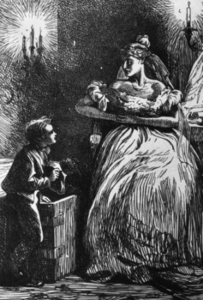
This was very uncomfortable, and I was half afraid. However, the only thing to be done being to knock at the door, I knocked, and was told from within to enter. I entered, therefore, and found myself in a pretty large room, well lighted with wax candles. No glimpse of daylight was to be seen in it. It was a dressing-room, as I supposed from the furniture, though much of it was of forms and uses then quite unknown to me. But prominent in it was a draped table with a gilded looking-glass, and that I made out at first sight to be a fine lady’s dressing-table.
Whether I should have made out this object so soon, if there had been no fine lady sitting at it, I cannot say. In an arm-chair, with an elbow resting on the table and her head leaning on that hand, sat the strangest lady I have ever seen, or shall ever see.
She was dressed in rich materials – satins, and lace, and silks – all of white. Her shoes were white. And she had a long white veil dependent from her hair, and she had bridal flowers in her hair, but her hair was white. Some bright jewels sparkled on her neck and on her hands, and some other jewels lay sparkling on the table. Dresses, less splendid than the dress she wore, and half-packed trunks, were scattered about. She had not quite finished dressing, for she had but one shoe on – the other was on the table near her hand – her veil was but half arranged, her watch and chain were not put on, and some lace for her bosom lay with those trinkets, and with her handkerchief, and gloves, and some flowers, and a prayer-book, all confusedly heaped about the looking-glass.
It was not in the first few moments that I saw all these things, though I saw more of them in the first moments than might be supposed. But, I saw that everything within my view which ought to be white, had been white long ago, and had lost its lustre, and was faded and yellow. I saw that the bride within the bridal dress had withered like the dress, and like the flowers, and had no brightness left but the brightness of her sunken eyes. I saw that the dress had been put upon the rounded figure of a young woman, and that the figure upon which it now hung loose, had shrunk to skin and bone. Once, I had been taken to see some ghastly waxwork at the Fair, representing I know not what impossible personage lying in state. Once, I had been taken to one of our old marsh churches to see a skeleton in the ashes of a rich dress, that had been dug out of a vault under the church pavement. Now, waxwork and skeleton seemed to have dark eyes that moved and looked at me. I should have cried out, if I could.
“Who is it?” said the lady at the table.
“Pip, ma’am.”
“Pip?”
“Mr. Pumblechook’s boy, ma’am. Come – to play.”
“Come nearer; let me look at you. Come close.”
It was when I stood before her, avoiding her eyes, that I took note of the surrounding objects in detail, and saw that her watch had stopped at twenty minutes to nine, and that a clock in the room had stopped at twenty minutes to nine.
“Look at me,” said Miss Havisham. “You are not afraid of a woman who has never seen the sun since you were born?”
I regret to state that I was not afraid of telling the enormous lie comprehended in the answer “No.”
“Do you know what I touch here?” she said, laying her hands, one upon the other, on her left side.
“Yes, ma’am.” (It made me think of the young man.)
“What do I touch?”
“Your heart.”
“Broken!”
She uttered the word with an eager look, and with strong emphasis, and with a weird smile that had a kind of boast in it. Afterwards, she kept her hands there for a little while, and slowly took them away as if they were heavy.
“I am tired,” said Miss Havisham. “I want diversion, and I have done with men and women. Play.”

A) How is Pip feeling in this extract?( POINT)
It may be helpful to track the feelings via several PEEL paragraphs if you are dealing with a long extract
Pip seems to be feeling both fearful and curious, as he anticipates meeting Miss Havisham for the first time in her grand home.
Pip appears to feel fearful and awkward when he meets Miss Havisham for the first time. She is evidently from a social class far above him and this intimidates Pip.
The young narrator Pip, seems rather awkward yet full of courage too, when he knocks on the door of Miss Havisham’s strange room. This combination makes Pip immediately sympathetic to the reader.
Pip’s behaviour suggests competing emotions as he anticipates meeting Miss Havisham for the very first time. He appears fearful, yet courageous and curious too.
Pip is feeling clearly out of his depth emotionally as he anticipates meeting Miss Havisham for the first time. We understand he is young and inexperienced and this makes him sympathetic.
Pip appears both resilient yet fearful too, as he encounters Miss Havisham for the first time in Satis House. The reader admires his determination. Pip expresses awakwardness and fear at the beginning of the extract as he is confronted by a challenging situation. These feelings engender immmediate sympathy and make the reader concerned for his fate.
Pip seems confused at the beginning of the extract and this confusion creates a marked sense of suspense.
B) Write out an example from the text that supports your answer. (EXAMPLE)
”I was half afraid.’
‘This was very uncomfortable, and I was half afraid’
‘the strangest lady I have ever seen, or shall ever see.’
C) Explain how your example shows how Pip is feeling during his meeting with Miss Havisham. (EXPLANATION)
D)Now develop your point so that your answer links to the next point and example. DEVELOP/LINK)
Repeat the exercise, either finding similar feelings and examples or offering an example of a shift or change.
Peel paragraphs should resemble the ocean’s waves. Think about the way each wave connects to the one before it, as well as to the one after it. These connections give your writing a sense of coherence. The connections also make it easy for the reader to follow the movement of your ideas and argument.