Learning requires investment. Investment of time and investment of emotion and applied curiosity. When we learn anything we have to pay attention, we have to focus, even unconsciously on the matter at hand. When students find English studies dull or difficult or both, I always go back to reading. Do you read I ask? Invariably the answer is no. And then when I hear writing ideas, the tendency is to skim the surface of the situation, to remain very much a skater rather than an excavator.Here’s an excellent example of a writer excavating. It’s Dylan Thomas and an extract was used in 2017’s GCSE .One Christmas was so much like another, in those years around the sea-town corner now and out of all sound except the distant speaking of the voices I sometimes hear a moment before sleep, that I can never remember whether it snowed for six days and six nights when I was twelve or whether it snowed for twelve days and twelve nights when I was six.
All the Christmases roll down toward the two-tongued sea, like a cold and headlong moon bundling down the sky that was our street; and they stop at the rim of the ice-edged fish-freezing waves, and I plunge my hands in the snow and bring out whatever I can find. In goes my hand into that wool-white bell-tongued ball of holidays resting at the rim of the carol-singing sea, and out come Mrs. Prothero and the firemen.
It was on the afternoon of the Christmas Eve, and I was in Mrs. Prothero’s garden, waiting for cats, with her son Jim. It was snowing. It was always snowing at Christmas. December, in my memory, is white as Lapland, though there were no reindeers. But there were cats. Patient, cold and callous, our hands wrapped in socks, we waited to snowball the cats. Sleek and long as jaguars and horrible-whiskered, spitting and snarling, they would slink and sidle over the white back-garden walls, and the lynx-eyed hunters, Jim and I, fur-capped and moccasined trappers from Hudson Bay, off Mumbles Road, would hurl our deadly snowballs at the green of their eyes. The wise cats never appeared.
What a wonderful STORY we hear as we read on: this is dreamy, blurry with straightforward ‘truth’ and yet feels very personal and affectionate. The seemingly random, even cruel mention of the cats, gives the story a singular focus, and then the way the cats and boys become interchangeable in terms of the descriptive language, gives an idiosyncratic power to this memory. We ‘meet’ characters like ‘Jim’ and ‘Mrs Prothero’ and these specific details bring a richness to the narrative. Whatever happens in a story, it has to feel ‘real’ even if it may not be the truth. Dylan Thomas suggests that the’ distant speaking of the voices’ from the past, still haunt him before he falls asleep. They remain real to him, even if the means of relating the story seems more like a fairytale. He’s excavated the emotions and imaginative attitudes of his younger self.Stories make us fall in love, make us buy things, make us wake up. When we hear a story that we like, we light up inside and lean into the story. We turn on our ears and even our hearts to the words that take us places emotionally.It’s just been examination season and I caught myself frequently ‘selling’ Great Expectations before we even read a word of the(supposedly) dreaded comprehension text. And I noticed that the enthusiasm for the comprehension improved, even ‘heated up’ because the framing story, the ‘pre-story’ excited my students enough to approach the task with lively curiosity rather than resignation.





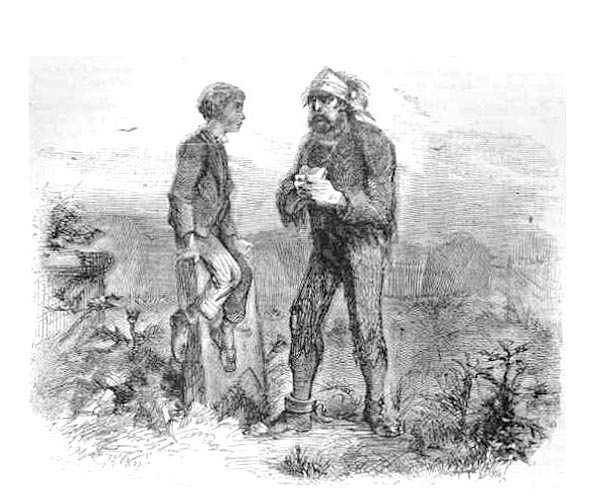
Here’s a story…Imagine you’re an orphan boy about eight years old, and you’re bullied at home. You’re lonely and sometimes you feel really curious about your dead family. So you go to the village graveyard and start reading the grave-stones. It’s rather an isolated graveyard and all you can see when you look up are the marshes and maybe even an odd gibbet where they used to hang pirates. But you’re brave and you carry on reading the gravestones and you’re just getting ideas about your mum and dad and even your brother and sisters from the shape of the graves, when an escaped convict appears from behind a stone, grabs you and threatens to murder you.Here’s another…Imagine a family who daren’t make a noise because noises kill and then the little boy finds a toy and a couple of batteries. He’s thrilled. He wants to play. But anything that makes a sound can kill you. What would you do? ….Here is the film. The Quiet Place.Students studying Macbeth often talk about the eponymous protagonists’ escalating ambition. They talk about the dangerous control of Lady Macbeth and her evil. Sometimes they mention the letter scene as a clear illustration of her interfering ways, of her malign plotting. Yet despite these sound comments, I sense a flatness to their insights. I detect a lacklustre enthusiasm and definitely a feeling of deja vu with such comments. They are SKATING over the surface of the text.So much of GCSE critical writing seems safe, competent but uninspired, barely felt. Hardly surprising you might say when the pressure on grades is so high.Yet with only a small adjustment, great originality and enthusiasm can be attained. A more compelling, human story might unfold out of the competent version of events that deliver students from sameness.So tell yourself a better story. Make it thrilling, suspenseful and psychologically compelling. Make it real.So here’s the tale of Macbeth again: A passionate but deeply insecure, possibly impotent warrior allows a series of malign temptresses to persuade him to kill his King. Unsurprisingly, disaster follows and the usurper realises the hollowness of succcess. He displaces his impotence through murder. Thus, terrible, bloody consummation of the Macbeths’ ‘baby’ plan, results in utter destruction and nothingness. Sterility reigns!