
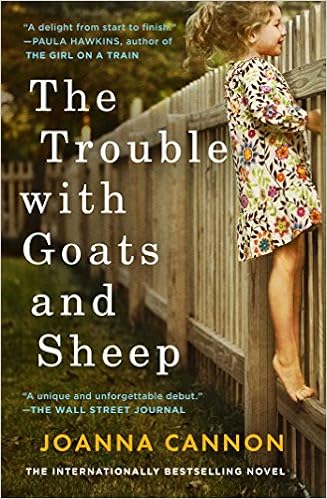
Joanna Cannon’s best-selling first novel The Trouble with Goats and Sheep explores the secrets of seventies’ suburbia through the eyes of two ten year old detectives, who decide to spend their long summer holiday trying to find a missing neighbour, Mrs Creasy. The narrative evokes the stifling summer heat of 1976, gradually excavating the troubling secrets that fester below the barely neighbourly community of The Avenue.I loved the wry wit of the novel which brilliantly attaches itself to the period detail and reveals the dark ambivalence of suburban intimacy. The self appointed child detectives are compelling characters, particularly the ever- anouraked Tilly, whose spirited vulnerability brings another undercurrent to the story and renders her perceptions sometimes more exposing than her side- kick Grace. Grace, however is the first person narrator, and even if a little too articulate to be a truly convincing child, delivers up an episodic tale of charm and slow build suspense – and what may even evolve into justice.In a scene involving the bullying compassion-free Harold Forbes, and his memory challenged wife Dorothy, the narrator (Grace), neatly puts the bully in his place with the telling irony of her perfectly timed reminder:I handed him the envelope.’ You’ve forgotten your letter, ‘ I said.The children’s defence of the preyed -upon -Mrs Forbes results in shared, healing laughter and the poignancy of Grace’s realisation feels more like an epiphany than simple recognition.‘ …whilst we were laughing, I looked at Mrs Forbes, and I looked over at the girl on the mantlepiece who laughed with us through the corridor of time, and I realised that they were a perfect match after all.’The re- matching of the older Mrs Forbes with her younger self, provides the reader with a pathos laden representation of one of the novel’s key conflicts, namely the uneasy relationship between vulnerability and judgement. In this instance we are aware that Mrs Forbes is not without her own buried secrets or fallibility, but for a passing moment, her victimisation by her predatory partner ceases and she enjoys the healing release of triumphant laughter. She enjoys a temporary reunion and even communion(through the aptly named Grace) with her earlier innocence, as symbolised by the photograph of her younger self.Suburban adulthood in Cannon’s avenue world, is a stifling, barely open prison.The acute observations of both young protagonists slice away at hypocrisy and petty cruelty, animating the narrative in an immediately fresh and original manner. The exceptional heat of the singular summer shrouds everything in mystery too. The Avenue is a place of enforced connections, where no friendship or antipathy is quite what it seems. Ironically, even the two protagonists are tested and at least one of them is found lacking. I don’t want to spoil the story in by giving anymore away, so I would just suggest you read Joanna Cannon’s novel this summer. Her language is tender yet incisive, sardonic yet tolerant, intelligent without self-conscious cleverness or show.And practically every page made me smile.I loved it.


Wonderfully persuasive! It sounds excellent- I will have to ‘take a look! ‘