
Rome. 30 November 1820.
My dear Brown,
‘Tis the most difficult thing in the world to me to write a letter. My stomach continues so bad, that I feel it worse on opening any book, – yet I am much better than I was in Quarantine. Then I am afraid to encounter the proing and conning of any thing interesting to me in England. I have an habitual feeling of my real life having past, and that I am leading a posthumous existence. God knows how it would have been – but it appears to me – however, I will not speak of that subject. I must have been at Bedhampton nearly at the time you were writing to me from Chichester – how unfortunate – and to pass on the river too! There was my star predominant! I cannot answer any thing in your letter, which followed me from Naples to Rome, because I am afraid to look it over again. I am so weak (in mind) that I cannot bear the sight of any hand writing of a friend I love so much as I do you. Yet I ride the little horse, – and, at my worst, even in Quarantine, summoned up more puns, in a sort of desperation, in one week than in any year of. my life. There is one thought enough to kill me – I have been well, healthy, alert &c, walking with her – and now – the knowledge of contrast, feeling for light and shade, all that information (primitive sense) necessary for a poem are great enemies to the recovery of the stomach. There, you rogue, I put you to the torture, – but you must bring your philosophy to bear – as I do mine, really – or how should I be able to live? Dr Clarke is very attentive to me; he says, there is very little the matter with my lungs, but my stomach, he says is very bad. I am well disappointed in hearing good news from George, – for it runs in my head we shall all die young. I have not written to x x x x x yet, which he must think very neglectful; being anxious to send him a good account of my health, I have delayed it from week to week. If I recover, I will do all in my power to correct the mistakes made during sickness; and if I should not, all my faults will be forgiven. I shall write to x x x to-morrow, or next day. I will write to x x x x x in the middle of next week. Servern is very well, though he leads so dull a life with me. Remember me to all friends, and tell x x x x I should not have left London without taking leave of him, but from being so low in body and mind. Write to George as soon as you receive this, and tell him how I am, as far as you can guess; – and also a note to my sister – who walks about my imagination like a ghost – she is so like Tom. I can scarcely bid you good bye even in a letter. I always made an awkward bow.
God bless you !
John Keats.
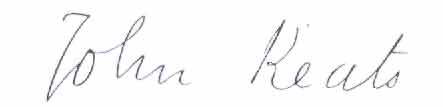

Notes: The Xs in the letter represent names marked out by Brown or a later copyist.
This is the last surviving letter of the poet John Keats. Just over two months later he was dead . I find this letter courageous in his acknowledgement of his now ‘posthumous existence.’ He is too ill to re-enter his previous life; good health has become foreign to him and memory nearly destroys his fragile composure. ( He would never see his great love Fanny Brawne again. ) Anyone who has been very ill knows the truth of this feeling of mourning for an earlier ‘healthy’ previous self. Illness makes us spectral in so many different ways.
I like to think that his proximity to death brought his tragically predeceased sister to help him. So much in this letter suggests spiritualilty and spectral presence, the sense of hauntings seen and unseen.. so much the awkwardness and bleak finality of farewell. ..his last gesture to his friend through the evocation of the bow is pure tragic theatre. A last letter, last writing. A gentle man to the end. A man for all seasons !
Wonderful.