
Macbeth and Ambiguity. (ONE)
When critically reading any text it is always illuminating to explore the moments when something strikes you as strange or ambiguous. These moments are worthy of reconsideration because they have affected your imagination and may lead to a greater understanding of the text’s power and message.
Moments of heightened ambiguity open up a text to revelation. They also give you LOTS of possibilities anchored to a single quotation.
So here are a few moments in Macbeth that felt ambiguous to me and might open up debate around gender roles and the destructive versions of masculinity represented in the play.
1) ‘ What bloody man is that?’ (Act One, Scene Two) Duncan’s first question is also the first human voice we hear in the play after we have encountered the witches in their deserted place claiming that ‘fair is foul.’ Shakespeare unnervingly juxtaposes the supernatural world and words of the witches with human chaos and legitimate violence.
It might even feel as if the one world triggers the other or at the very least , that these supposed exclusive worlds have an unhealthy connection or co-dependency at times.
The ambiguous question about the location(and identity) of suffering, leads the audience to the wounded Sergeant testifying to the terrifying violence (legitimately)committed by Macbeth in defence of Duncan’s Kingship. ‘ Like Valor’s minion carved out his passage ….till he unseamed him.’ Notice the awe engendered by the Sergeant’s simile and the implications of the verb, ‘carved’ which its sense of graphic viciousness and premeditation.
This brutal dismemberment of ‘merciless Macdonwald’ is also immediately applauded by Duncan, ‘ Oh valiant cousin! Worthy gentleman!’ Duncan’s deployment of the exclamative is interesting as it suggests relief at Macbeth’s loyalty, as well as the preservation of his own Kingship. This relationship between Macbeth’s murderous brilliance on the battlefield and the continuation of Duncan’s own reign as King is important and of course becomes tragically ironic.
This indebtedness is also sealed by the collapsing Sergeant with the exclamation that Macbeth and Banquo’s violent courage and predilection for ‘reeking wounds ‘ resembled ‘another Golgotha’. Once again, this world of masculine violence and cruelty foreshadows what is to befall Scotland once Duncan is deposed. ‘Golgotha’ is another name for Calvary, the hill was Christ was crucified, so once again the audience would be aware of the deeply ambiguous nature of Macbeth’s capacity for violence on the battlefield. Who or what we might wonder, will be sacrificed ( ‘crucified’) next?
1 B) This celebration of Macbeth’s victory though appalling violence gives the audience an immediate and unforgettable insight into the state of Scotland and establishes Macbeth as a courageous and highly committed killer. The value that is attached to such butchery shows that potent masculinity is defined by physical action and violence. Yet, by the end of the play, Macbeth is dismissed ( by Malcolm) as being a ‘ dead butcher’ and Lady Macbeth as being a ‘fiend-like queen.’ Yet surely Macbeth has been a butcher all the time? He has just transgressed his allegiances. So why the ambiguity? Are we meant to assume that there must remain a place of loyalty and moral sanctuary amid this violence and the transgression and violation of such a sanctuary bring ruination, even to the transgressors themselves?
2) Lady Macbeth first appears to the audience reading a letter from her beloved husband whose name defines her and limits her too.(She is an accessory to Macbeth rather than enjoying her own independent identity). Her marriage seems close and intimate, so the encounter with the witches must be shared even before Macbeth arrives home. But why this need for testimony?? Is it a form of priming so that Lady Macbeth is prepared to persuade her husband to kill the King? There is considerable ambiguity as to why Macbeth needs to warn Lady Macbeth of the witches ‘ prophecy and we might assume that he values her option and even her marked powers of persuasion!
It is also strange that Lady Macbeth’s ruminations include the surprising revelation that ‘ I do fear thy nature. It is too full o’ th’ milk of human kindness To catch the nearest way.’ After hearing about the brutality of Macbeth on the battlefield wreaking his ‘ bloody execution’ this alternative version of her husband surprises the audience. The word ‘kindness’ jars and seems incongruent with what we know of Macbeth’s charcter so far.
Is she lying to herself even in her soliloquy, or flaunting the degree of intimacy she shares with this brutal warrior? Does she know more about her husband’s character than we do? Whatever the reason, it is notable that the ‘kindness’ is discredited and compassionate behaviour seen as weakness. Notice the sue of the verb ‘fear’ underlining the sense that Lady M sees ‘kindness’ as an obstacle that needs eradicating.
These ordinarily virtuous behaviours are often associated with maternal or feminine behaviour and it is apparent that in this world, the humane has certainly deserted the human!
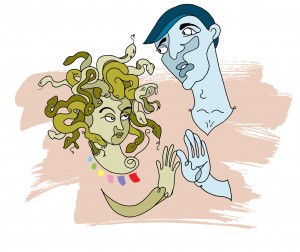
2.B) Think also about the appearance of the witches and the significance of Banquo’s admission that,‘ You should be women, And yet your beards forbid me to interpret That you are so.’ This ambiguity surrounding the gender of the witches is fascinating as it links their ambiguity to power. If they are not conventionally feminine and even wear the masculine beard then this underlines the perceived inferiority of femininity, even if in the witches case, their powerful subversion renders them aesthetically repulsive.
Likewise, Lady Macbeth will try to rid herself of her feminine identity to claim the authority(potency) to destroy Duncan. She credits violent masculinity with worldly success, so calls upon ‘spirits’ to ‘ unsex me here.’ This desire to destroy her femininity through a form of malevolent maternity,’ take my milk for gall.’ Is shockingly admired a little later by her besotted husband, ‘bring forth men-children only.’ This admiration suggests that Macbeth shares his wife’s denigration of the feminine aspects of himself and perhaps that he fears the sense of vulnerability that lives inside him, even though the masculine aspects will destroy the King and his own noble, virtuous self.
Ironically the Macbeths have no children and the evocation of ‘men-children’ thus seems a fantasy of potency, that both husband and wife are happy to share. The ambiguity around potency and manliness is something we can think about next, particularly when we think about the recurring and sometimes jeering question, ‘ Are you a man?’
